注解
注解
注解是放在 Java 源码的类、方法、字段、参数前的一种特殊“注释”。
注释会被编译器直接忽略,注解可以被编译器打包进入 class 文件,因此,注解是一种用作标注的“元数据”。
注解的作用
从 JVM 的角度来看,注解本身对于代码逻辑没有任何影响,如何使用注解完全由工具决定。
Java 中的注解可以分为三类:
@Override、@Deprecated、@SuppressWarnings等编译器注解,编译器会根据这些注解进行检查和警告。这类注解不会被编译进入 class 文件,编译后就会被丢掉。- 第二类是由工具处理
.class文件时使用的注解,这类注解会被编译进入 class 文件,但不会被 JVM 直接使用,而是由工具在处理 class 文件时读取和使用。 - 第三类是程序运行时能够读取的注解,它们被加载后会一直存在于 JVM 中,可以通过反射 API 读取和使用。
内置注解
@Override
表示当前方法覆盖了父类的方法。
此注释只适用于修饰方法,表示一个方法声明打算重写超类中的另一个方法声明。如果方法利用此注释类型进行注解但没有重写超类方法,则编译器会生成一条错误消息。
@Deprecated
表示方法已经过时,方法上有横线,使用时会有警告。
此注释可用于修饰方法、属性、类,表示不鼓励程序员使用这样的元素,通常是因为它很危险或存在更好的选择。在使用不被赞成的程序元素或在不被赞成的代码中执行重写时,编译器会发出警告。
@SuppressWarnings
用来抑制编译时的警告信息。与前两个注释有所不同,你需要添加一个参数才能正确使用,这些参数值都是已经定义好了的,我们选择性的使用就好了
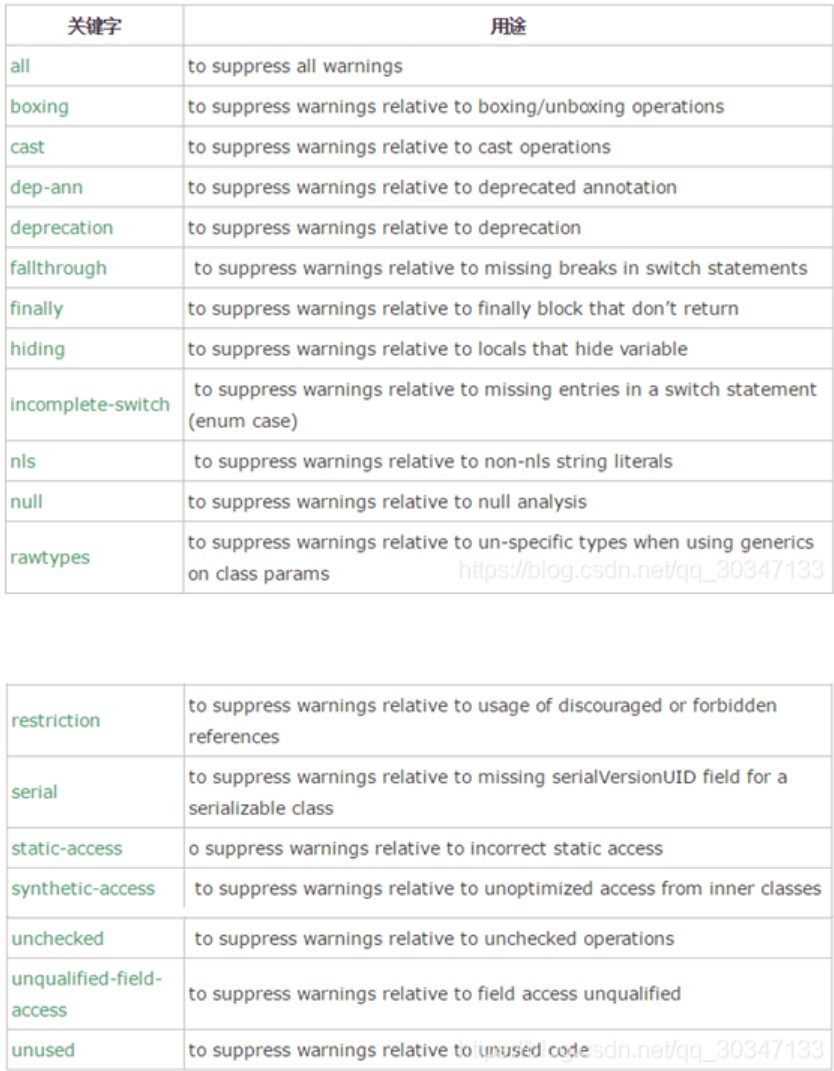
例如:
@SuppressWarnings(value={"unchecked", "deprecation"})定义注解
Java 中定义注解的语法和定义接口类似,使用 @interface 关键字来定义一个注解类型:
public @interface PostConstruct {
}
注解也可以有参数,参数的定义方式类似于接口中的方法定义:
public @interface Validator {
    int min();
    int max();
    String label() default "";
}
注解中的参数可以有默认值,如果没有默认值,则在使用注解时必须提供该参数的值。一般来说建议为注解中的参数设置默认值,这样在使用注解时就不需要每次都提供参数值了。
注解属性类型可以有以下列出的类型:
- 基本数据类型。
- String。
- 枚举类型。
- 注解类型。
- Class 类型。
- 以上类型的一维数组类型。
元注解
元注解顾名思义我们可以理解为注解的注解,它是作用在注解中,方便我们使用注解实现想要的功能。元注解分别有 @Retention、 @Target、 @Document、 @Inherited 和 @Repeatable(JDK1.8 加入)五种。
@Retention
Retention 英文意思有保留、保持的意思,它表示注解存在阶段是保留在源码(编译期),字节码(类加载)或者运行期(JVM 中运行)。在 @Retention 注解中使用枚举 RetentionPolicy来表示注解保留时期。
RetentionPolicy.SOURCE:注解只存在于源码中,class字节码文件中不包含。RetentionPolicy.CLASS:默认的保留策略,注解在 class 字节码文件中存在,但运行时无法获得。RetentionPolicy.RUNTIME:注解会在 class 字节码文件中存在,在运行时可以通过反射获取到。
如果不手动指定 @Retention 注解,则默认使用 RetentionPolicy.CLASS 策略。因此,如果想要在运行时通过反射获取注解信息,必须将注解的保留策略设置为 RetentionPolicy.RUNTIME。
@Retention(RetentionPolicy.RUNTIME)
public @interface PostConstruct {
}
@Target
Target 的英文意思是目标,这也很容易理解,使用 @Target 元注解表示我们的注解作用的范围就比较具体了,可以是类,方法,方法参数变量等,同样也是通过枚举类 ElementType表达作用类型。
下面是 ElementType 的汇总表:
| 枚举值 | 作用 / 说明 | 示例 / 备注 |
|---|---|---|
ElementType.TYPE | 作用于类型声明:类、接口、枚举、注解 | 注解用于类/接口声明,例如用于标注某个注解可用于类。 |
ElementType.FIELD | 作用于字段或枚举常量 | 注解字段或枚举常量。 |
ElementType.METHOD | 作用于方法声明 | 注解普通方法(包括抽象/默认方法)。 |
ElementType.PARAMETER | 作用于方法或构造函数的形参 | 示例:void m(@A String s),注解方法参数。 |
ElementType.CONSTRUCTOR | 作用于构造函数 | 注解构造方法声明。 |
ElementType.LOCAL_VARIABLE | 作用于局部变量 | 注解方法体内的局部变量或迭代变量。 |
ElementType.ANNOTATION_TYPE | 作用于注解类型的声明(即用于定义注解) | 用于定义“元注解”,例如注解另一个注解的声明。 |
ElementType.PACKAGE | 作用于包声明 | 在 package-info.java 中使用以标注包。 |
ElementType.TYPE_PARAMETER | 作用于类型参数声明(泛型声明处);JDK 1.8 新增 | 示例:class C<@A T>,注解泛型类型参数声明。 |
ElementType.TYPE_USE | 作用于“类型使用”位置(几乎所有出现类型的地方);JDK 1.8 新增 | 用于类型注解,如 @NonNull String、强制转换、泛型实际类型、implements、throws 等。 |
@Target 注解的参数是一个 ElementType 枚举值的数组,表示注解可以作用于哪些 Java 元素,如果只有一个元素,可以直接写成单个枚举值:
import java.lang.annotation.ElementType;
import java.lang.annotation.Target;

@Target({
        ElementType.METHOD,
})
public @interface PostConstruct {
}
@Document
Document的英文意思是文档。它的作用是能够将注解中的元素包含到 Javadoc 中去。
@Inherited
Inherited 的英文意思是继承,但是这个继承和我们平时理解的继承大同小异,一个被 @Inherited 注解了的注解修饰了一个父类,它的子类也会继承父类的注解。
@Target(ElementType.TYPE)
@Documented
@Retention(RetentionPolicy.RUNTIME)
@Inherited
@interface InheritedTest{

}

@InheritedTest
class Father{

}

class Son extends Father{

}
public class MetaAnnotation {
    public static void main(String[] args) {
        Class<Son> sonClass = Son.class;
        Annotation[] annotations = sonClass.getAnnotations();
        for (Annotation annotation : annotations) {
            System.out.println(annotation);
        }

    }
}
提示
@Inherited 仅对 @Target(ElementType.TYPE) 的注解有效,即只能作用于类、接口、枚举和注解类型的声明。
@Repeatable
Repeatable 的英文意思是可重复的。顾名思义说明被这个元注解修饰的注解可以同时作用一个对象多次,但是每次作用注解又可以代表不同的含义。
/**
 * 一个人喜欢玩游戏,他喜欢玩英雄联盟,绝地求生,极品飞车,尘埃4等,
 * 则我们需要定义一个人的注解,
 * 他属性代表喜欢玩游戏集合,
 * 一个游戏注解,游戏属性代表游戏名称
 * @author 16582*/
@Documented
@Retention(RetentionPolicy.RUNTIME)
@Target(ElementType.TYPE)
@interface People {
    Game[] value() ;
}
/**游戏注解
 * @author 16582*/
@Repeatable(People.class)
@Retention(RetentionPolicy.RUNTIME)
@Target(ElementType.TYPE)
@interface Game {
    String value() default "";
}
/**玩游戏类*/
@Game(value = "LOL")
@Game(value = "PUBG")
@Game(value = "NFS")
@Game(value = "Dirt4")
class PlayGame {
}
处理注解
注解本身是 Annotation 接口的子接口,因此注解也是一种接口类型,可以拿到注解的 Class 对象,进而通过反射 API 获取注解的信息。
接下来实现两个实例代码,分别是实现 @PostConstruct 注解和 @Validator 注解的处理。
首先是 @PostConstruct 注解的处理,我们希望这个自定义注解在类的方法上使用,当类被构建时,这个方法会调用。
public class Main {

    static Object newInstance(Class<?> clazz) throws Exception {
        Object instance = null;
        for (Constructor<?> constructor : clazz.getConstructors()) {
            if (constructor.getParameterCount()==0) {
                instance = constructor.newInstance();
            }
        }
        for (Method method : clazz.getDeclaredMethods()) {
            if (method.isAnnotationPresent(PostConstruct.class) && method.getParameterCount() == 0) {
                method.invoke(instance);
            }
        }
        return instance;
    }

    static void main() throws Exception {
        newInstance(Base.class);
    }
}public class Base {
private String privateBaseStr;
public int publicBaseInt;
@PostConstruct
public void postConstruct() {
System.out.println("post construct method running");
}
}import java.lang.annotation.ElementType;
import java.lang.annotation.Retention;
import java.lang.annotation.RetentionPolicy;
import java.lang.annotation.Target;
@Target({
ElementType.METHOD,
})
@Retention(RetentionPolicy.RUNTIME)
public @interface PostConstruct {
}这个例子中我们通过 isAnnotationPresent 方法判断方法上是否有 @PostConstruct 注解,如果有就调用这个方法。
接下来是 @Validator 注解的处理,我们希望这个注解可以用在方法参数上,表示对参数进行校验。或者时作用在字段上,表示对字段进行校验。
import java.lang.reflect.*;

public class Main {

    static void valid(Object obj) throws Exception{
        Class<?> clazz = obj.getClass();
        for (Field field : clazz.getDeclaredFields()) {
            if (field.isAnnotationPresent(Validator.class) && field.getType() == int.class) {
                field.setAccessible(true);
                Validator annotation = field.getAnnotation(Validator.class);
                if (field.getInt(obj) < annotation.min() || field.getInt(obj) > annotation.max()) {
                    throw new RuntimeException(String.format("field %s value %d out of range [%d, %d]",annotation.label(), field.getInt(obj), annotation.min(), annotation.max()));
                }
            }
        }
    }

    static void main() throws Exception {
        int amount = 1;
        Request request = new Request();
        Method method = request.getClass().getDeclaredMethod("setAmount", int.class);
        for (Parameter parameter : method.getParameters()) {
            Validator annotation = parameter.getAnnotation(Validator.class);
            if (annotation != null && (amount < annotation.min() || amount > annotation.max())) {
                throw new RuntimeException(String.format("parameter value %d out of range [%d, %d]", amount, annotation.min(), annotation.max()));
            }
        }
        request.setAmount(amount);
        valid(request);
    }
}import java.lang.annotation.ElementType;
import java.lang.annotation.Retention;
import java.lang.annotation.RetentionPolicy;
import java.lang.annotation.Target;
@Retention(RetentionPolicy.RUNTIME)
@Target({
ElementType.FIELD,
ElementType.PARAMETER,
})
public @interface Validator {
int min();
int max();
String label() default "";
}public class Request {
@Validator(min = 0, max = 100, label = "amount")
private int amount;
public int getAmount() {
return amount;
}
public void setAmount(int amount) {
this.amount = amount;
}
}